
Boiler Breakdown in Winter: Causes, Prevention & What to Do When It Happens

If your boiler has broken down right now, the most likely cause is one of three things: lost pressure, a frozen condensate pipe, or a thermostat, timer or airlock fault. All three are common in winter, and two of them you can often check yourself in a few minutes before calling an engineer. This guide covers what causes winter boiler breakdowns, how to prevent one before it happens, and exactly what to do if you’re dealing with one right now.
Why Boilers Break Down More in Winter
Winter puts far more demand on a boiler than any other season; it’s running longer, more often, and harder, which is exactly when small existing issues turn into full breakdowns. Pipework that sits fine most of the year can freeze in a cold snap. Sludge or debris that’s been quietly building up inside the system restricts flow more noticeably under heavy use. And a boiler that’s been losing pressure slowly for months can finally drop below the point where it’ll fire at all, right when you need it most. None of this is really about winter causing new faults; it’s winter exposing ones that were already there.
Common Cause #1: Losing Pressure
This is by far the most common reason a boiler stops working in winter. Your boiler needs water at a certain pressure to operate safely, and that pressure can drop for a few reasons: bleeding a radiator recently, a slow, hard-to-spot leak somewhere in the system, or simply the system settling over time. However it happens, once pressure drops too low, most boilers will refuse to fire as a safety measure.
Checking your pressure takes seconds. Look at the pressure gauge on the front of your boiler; it’s usually a small dial or digital display, and most gauges mark a safe range in green, typically between 1.0 and 1.5 bar when your heating is cold.
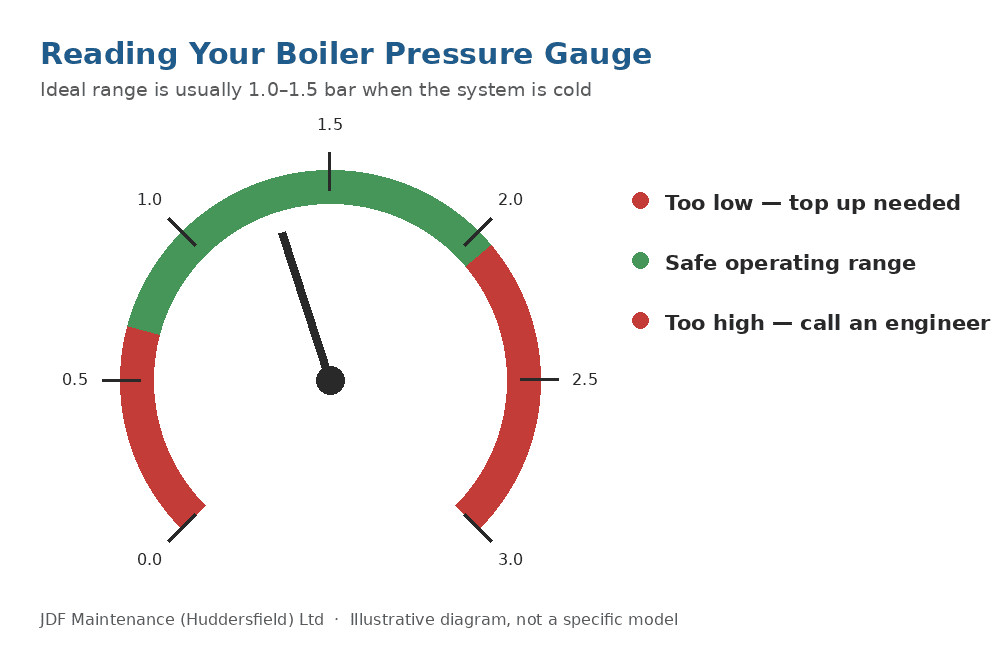
If the needle or reading sits in the green, pressure isn’t your problem. If it’s below the green zone, topping up is usually safe to do yourself using your boiler’s filling loop, a small valve, often underneath the boiler, that lets fresh water back into the system. Turn it slowly, watch the gauge, and stop as soon as you reach the middle of the green zone; overfilling is as unhelpful as underfilling. If you’re topping up more than once every few months, that points to a slow leak worth having looked at, rather than something to keep resolving yourself indefinitely.
Common Cause #2: Frozen Condensate Pipe
This is one of the most common winter-specific boiler faults in the UK. Modern condensing boilers produce a small amount of acidic waste water, which drains away through a plastic condensate pipe, often routed outside the house. In freezing weather, that water can freeze inside the pipe, blocking it and causing the boiler to shut down and show a fault code.
You can usually spot this yourself: look for the white plastic pipe running from the boiler to an outside wall, and check for ice, or for the boiler’s fault display mentioning a blockage. If you can safely reach it, thawing it with warm (not boiling) water poured over the pipe, or a covered hot water bottle held against it, is usually enough to get things moving again. Never use boiling water directly on the pipe, as the sudden temperature change can crack it.
Common Cause #3: Thermostat, Timer & Airlock Issues
Before assuming the worst, a few quicker checks are worth ruling out. Confirm your thermostat is actually set above room temperature and hasn’t had its batteries die. Check the timer or programmer hasn’t been knocked off schedule, especially after a power cut. And if certain radiators are cold while others work fine, an airlock or a radiator that simply needs bleeding is a common, easy-to-fix cause, not necessarily a boiler fault at all.
How to Prevent a Winter Breakdown
A handful of simple habits before and during winter catch most of these issues before they become a breakdown:
- Book a pre-winter service: an annual service catches pressure creep, sludge build-up and worn parts before the cold weather puts real demand on them. See our Boiler Servicing article for what’s included.
- Lag any exposed pipework, especially condensate pipes running outside or through unheated spaces like a garage; pipe insulation is inexpensive and takes minutes to fit.
- Bleed radiators showing cold spots before winter sets in, not after; trapped air makes a system work harder than it needs to. Our How to Bleed a Radiator guide walks through it step by step.
- Keep the heating on low overnight during a cold snap, rather than switching it off completely; a constant low background heat keeps pipework warmer than repeated full cool-downs and reheats.
What to Do If Your Boiler Breaks Down Now
If your boiler has stopped working right now, start with the checks above: pressure gauge, condensate pipe, thermostat and timer, since between them they solve the large majority of winter breakdowns without needing an engineer at all. If none of those explains it, or you’re not comfortable checking them yourself, that’s the point to call a Gas Safe registered engineer rather than keep investigating. Never attempt to open the boiler casing or work on the gas or electrical components yourself; that’s exactly the line between DIY-safe and not. If you smell gas at any point, this stops being a boiler fault: turn off the gas supply at the meter, don’t use naked flames or electrical switches, ventilate the area, and call the Gas Emergency Number on 0800 111 999 immediately.
Frequently Asked Questions
Why does my boiler keep losing pressure?
Usually one of three things: a recent radiator bleed, a slow leak somewhere in the system that isn’t always visible, or general wear as the system settles over time. Topping up occasionally is normal; needing to do it every few weeks points to a leak worth having checked.
Is it normal for a boiler to lose a little pressure over time?
Yes, a small, gradual drop over months is normal and easily topped up yourself. A sudden or repeated drop within days or weeks isn’t, and is worth having looked at rather than just keeping the gauge topped up indefinitely.
What do I do if my boiler breaks down in winter?
Check your pressure gauge, look for a frozen condensate pipe, and confirm your thermostat and timer are set correctly; these three cover most winter breakdowns. If none of that resolves it, call a Gas Safe registered engineer rather than continue investigating yourself.
How do I stop my boiler pipes freezing?
Lag any exposed pipework, particularly the condensate pipe if it runs outside, and keep your heating on low overnight during a cold snap rather than switching it off completely.
Is a losing-pressure boiler an emergency?
Not usually. If you can top it up yourself and it holds, it’s a routine job, not an emergency. It becomes worth an emergency call if you can’t safely top it up, if pressure keeps dropping rapidly, or if you smell gas at any point.
Need Help Now, or Planning Ahead?
If your boiler’s down right now, call JDF Maintenance on 07538 359920 for emergency boiler repair in Huddersfield, no call-out charge. If you’re reading this ahead of the cold weather, the simplest way to avoid a breakdown is a pre-winter check-up; get in touch, and we’ll book one in before the temperature drops.